

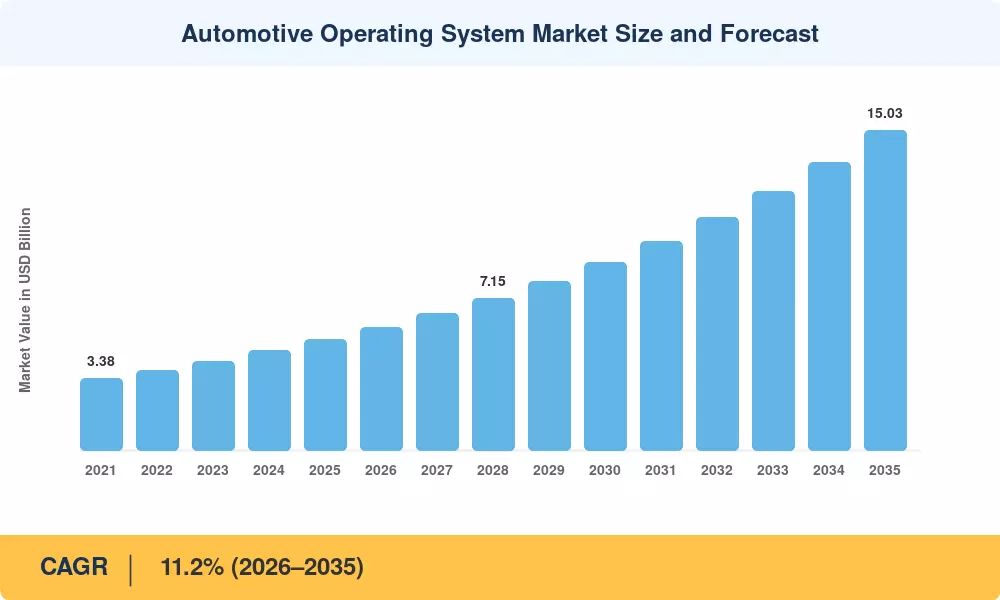
Automotive Operating System Market to Reach USD 15.03 Billion by 2035, Growing at 11.2% CAGR
Automotive Operating System Market
Europe leads the Automotive Operating System Market with 35% share, concentrated in Germany, France, and Sweden
NEW YORK, NY, UNITED STATES, August 31, 2026 /EINPresswire.com/ -- According to Market Research Future, the Automotive Operating System Market is projected to reach USD 15.03 Billion by 2035, registering a CAGR of 11.2% during the forecast period. This robust growth reflects the automotive industry's fundamental transformation toward software-defined vehicles, where operating systems have become the critical foundation for managing everything from infotainment and connectivity to advanced driver assistance systems and autonomous driving capabilities. The Automotive Software Market has experienced parallel expansion, with the broader automotive software ecosystem growing as vehicles increasingly rely on software for differentiation, functionality, and revenue generation.Market Overview
Automotive operating systems are specialized software platforms that manage vehicle hardware resources, provide application programming interfaces for software development, and enable the execution of diverse vehicle functions ranging from safety-critical systems to entertainment applications. These operating systems must meet rigorous automotive-grade requirements for reliability, real-time performance, functional safety, and security. The market encompasses various OS types including Linux-based systems, QNX (BlackBerry), Android Automotive, AUTOSAR (Classic and Adaptive), and proprietary real-time operating systems, each serving different vehicle domains and applications .
The key growth drivers propelling this market expansion include the increasing adoption of software-defined vehicle architectures, which shift vehicle value from hardware to software, requiring scalable and secure operating system platforms that can support continuous feature updates and lifecycle revenue models . The integration of advanced driver assistance systems and the progression toward autonomous driving demand operating systems capable of real-time sensor fusion, low-latency processing, and functional safety compliance . The rapid electrification of vehicles has created additional demand, as electric vehicles require sophisticated software for battery management, thermal control, and energy optimization .
Technological developments are reshaping the automotive OS landscape at an accelerating pace. The industry is witnessing a significant shift toward open-source platforms such as Android Automotive OS and Linux-based systems, which enable faster development cycles, broader ecosystem participation, and greater customization options . Real-time operating systems like QNX remain critical for safety-certified applications, with BlackBerry's QNX SDP 8.0 release simplifying safety-critical embedded system development . The emergence of hypervisor-based operating systems enables multiple OS instances to run on a single hardware platform, supporting the consolidation of domain controllers and centralized vehicle architectures .
Policy and regulatory frameworks play a crucial role in shaping market dynamics. UNECE R155/R156 compliance requirements mandate cybersecurity management and over-the-air update capabilities, driving adoption of secure OS platforms . ISO 26262 functional safety standards require operating systems to meet stringent ASIL certification levels, influencing platform selection and development processes . Regional regulatory variations across North America, Europe, and Asia Pacific add complexity to OS deployment and certification, requiring adaptable platforms that can meet diverse compliance requirements .
Market Segmentation
The automotive operating system market is segmented based on OS type, application, and vehicle type to provide comprehensive insights into the industry landscape .
By OS Type: The market is categorized into Linux-Based, QNX (BlackBerry), Android Automotive, AUTOSAR (Classic & Adaptive), and Others including proprietary and real-time operating systems. Android Automotive is projected to record the highest CAGR, driven by growing demand for user-friendly in-vehicle infotainment interfaces and its extensive app ecosystem, which allows automakers to offer a wide range of applications and services from navigation to voice assistants . QNX-based systems remain dominant in safety-critical automotive applications, providing the real-time performance required for ADAS and autonomous driving functions . AUTOSAR, both Classic and Adaptive platforms, serves as the industry standard for ECU software architecture, enabling interoperability across different hardware and software components .
By Application: The market covers Infotainment, ADAS & Autonomous Driving, Telematics & Connectivity, and Powertrain & Chassis Control. Infotainment systems historically held the largest share, driven by consumer expectations for seamless smartphone integration, multimedia experiences, and voice assistants . However, ADAS and autonomous driving applications are expected to register the most significant growth, as regulatory mandates for safety features and the progression toward autonomous vehicles require advanced OS capabilities . Telematics and connectivity applications are growing rapidly as connected vehicle ecosystems demand seamless communication between vehicles and external networks .
By Vehicle Type: The market serves Passenger Cars, Commercial Vehicles, and Two- & Three-Wheelers. Passenger cars represent the dominant segment, with passenger vehicles increasingly leveraging software-defined architectures to enable advanced infotainment, ADAS, and personalized over-the-air updates . Commercial vehicles represent a growing segment valued at approximately USD 1.14 billion in 2025, driven by fleet telematics, driver monitoring, and predictive maintenance applications . Electric vehicles average 40% higher software content per vehicle compared to equivalent internal combustion engine models, creating additional demand for specialized OS platforms .
By Region: The market analysis covers North America, Europe, South America, Asia Pacific, and the Middle East and Africa .
🛒 You can buy this market report at:
https://www.marketresearchfuture.com/checkout?currency=one_user-USD&report_id=11896
Regional Analysis
North America represents a significant and mature market for automotive operating systems, driven by a highly advanced automotive and technology ecosystem . The United States leads with strong adoption of connected car platforms, ADAS, and software-defined vehicle architectures, supported by major automakers and tech firms . High investments in AI, cloud computing, and vehicle software integration accelerate OS deployment, while early adoption of autonomous technologies and robust digital infrastructure reinforce the region's leadership .
Asia Pacific emerges as the fastest-growing regional market, fueled by rapid expansion of the automotive and electric vehicle industries . China dominates due to large-scale EV production and strong push toward smart vehicles, with domestic automakers aggressively integrating advanced operating systems for smart dashboards, vehicle connectivity, and autonomous driving support . Chinese OEMs are actively reducing dependence on Western OS platforms, with Huawei's HarmonyOS-powered cockpits shipping in over 600,000 vehicles during 2024, while Baidu's Apollo OS targets the mid-segment market . India is experiencing growth through partnerships with cloud providers for connected-vehicle services and adoption of open-source OS stacks . Japan and South Korea drive innovation in automotive electronics and EV battery technologies .
Europe holds a leading position in the automotive operating system market, driven by strong adoption of connected and software-defined vehicles . German automakers are transitioning aggressively toward centralized software platforms, reducing ECU complexity and enabling scalable vehicle architectures . The region's strong emphasis on vehicle software standardization, digital cockpit integration, and cross-OEM platform collaboration supports OS deployment in infotainment, body control, and driver assistance applications . European regulatory requirements for cybersecurity and over-the-air updates further accelerate OS adoption .
South America and the Middle East and Africa represent developing markets with growing potential. Brazil is experiencing growth as domestic and international manufacturers increase introduction of connected and digitally enabled vehicles . The UAE is positioning as a regional hub for smart and connected mobility, with strong adoption of premium vehicles and intelligent mobility solutions driving OS deployment .
Competitive Landscape and Key Players
The automotive operating system market is highly competitive, featuring a mix of established technology companies, specialized software providers, and collaborative industry consortia . The competitive landscape is characterized by technological innovation, strategic partnerships, and ecosystem development.
Key players operating in this market include BlackBerry Limited (QNX), Alphabet Inc. (Google Android Automotive), Microsoft Corporation, Apple Inc., Wind River Systems, Green Hills Software, Elektrobit, NVIDIA Corporation, Red Hat, and Baidu, Inc. . The competitive arena is defined by a blend of established technology giants and specialized software providers, with open-source initiatives and proprietary platforms coexisting to serve different market needs .
Strategic developments are reshaping the competitive landscape. In August 2025, BlackBerry released QNX SDP 8.0, a safety-certified operating system based on microkernel architecture for automotive and other safety-critical sectors . In March 2025, Hyundai Motor Group launched its 'Pleos' software brand, a mobility software platform supporting autonomous movement and smart device management . In March 2025, Li Auto released its proprietary Harmony Halo OS, the world's first open-source automotive operating system . In October 2025, Red Hat launched its in-vehicle operating system, achieving ISO 26262 ASIL-B certification as the first open-source Linux system for automotive safety applications .
Competitive positioning increasingly depends on ecosystem compatibility and strategic alliances . Software vendors are aligning with semiconductor manufacturers to optimize performance for specific chip families, while joint development agreements with OEMs accelerate time-to-market for tailored solutions . Cloud service providers are extending their infrastructure to support vehicle-to-cloud architectures, enabling seamless telematics integration . The boundaries between hardware and software suppliers are dissolving as companies seek integrated, full-stack offerings addressing the complete lifecycle needs of modern vehicles .
Latest Industry News and Developments
Recent industry developments highlight the dynamic nature of the automotive operating system market. In November 2025, LG Electronics announced its webOS-based Automotive Content Platform would power new Kia models in Europe, including the EV3, EV4, EV5, and new Sportage, enabling advanced infotainment and connected features .
At CES 2025, Panasonic Automotive Systems and Qualcomm Technologies announced an enhanced partnership to redefine in-vehicle experiences, utilizing Qualcomm's Snapdragon Cockpit Elite to power new Cockpit Domain Controllers with integrated generative AI for software-defined vehicles .
In May 2024, Red Hat and Renesas teamed up to create a flexible compute platform for software-defined vehicles, integrating Red Hat's In-Vehicle Operating System with Renesas' R-Car Software Development Kit to enable quicker deployment of new features .
Market Challenges and Opportunities
The automotive operating system market faces several key challenges that could impact growth trajectories. High integration and validation costs, ranging from USD 10-30 million per OEM integration program, create a cost barrier that limits OS proliferation among volume-segment automakers . Fragmented in-vehicle hardware architectures with over 70 distinct ECUs per vehicle force OS vendors to maintain costly hardware-abstraction layers . Semiconductor supply constraints for advanced SoCs, with automotive-grade 5 nm lead times averaging 32 weeks in 2024, indirectly slow OS deployment . Cybersecurity liability concerns and talent shortages in embedded automotive software further constrain market expansion .
Emerging opportunities are abundant in the evolving mobility landscape. The shift toward software-defined vehicles enables OEMs to treat vehicle OS as a platform for recurring revenue, with BMW, Mercedes-Benz, and Tesla collectively generating over USD 1.8 billion in software-related revenue in 2024 . Vehicle app stores and subscription models, feature-on-demand services, and data monetization through vehicle OS telemetry create new revenue streams . Emerging market leapfrog opportunities in India, Southeast Asia, and Brazil allow automakers to bypass legacy ECU architectures entirely by adopting cloud-native OS platforms from launch .
Future growth potential remains exceptionally strong, driven by the ongoing transition toward software-defined, connected, and autonomous vehicles. As vehicles increasingly become platforms for continuous innovation and service delivery, the importance of robust, scalable automotive operating systems will continue to grow. Organizations that embrace modular design principles, adopt hybrid open-source and proprietary development models, and invest in comprehensive cybersecurity frameworks will capture value in the rapidly evolving automotive software ecosystem .
To explore more market insights, visit us at:
https://www.marketresearchfuture.com/reports/automotive-operating-system-market-11896
Final Market Summary
The automotive operating system market is poised for substantial growth, driven by software-defined vehicle architectures, regulatory requirements, and technological innovation. The market's projected growth to USD 15.03 Billion by 2035 reflects the critical importance of operating systems in enabling modern vehicle functions and the increasing software content per vehicle.
The long-term industry potential remains strong, with advancements in real-time operating systems, AI integration, and cloud connectivity continuing to expand the addressable market. The convergence of automotive operating systems with broader mobility ecosystems, including autonomous driving, electric vehicle platforms, and connected vehicle services, is creating comprehensive solutions that serve diverse customer needs across vehicle segments and geographic regions.
Key factors expected to influence future development include the pace of software-defined vehicle adoption, advancements in safety certification standards, and the evolution of regulatory frameworks. The development of secure, scalable OS platforms that support continuous updates and feature enhancements will enable manufacturers to meet the evolving demands of connected and autonomous vehicles. As vehicles become increasingly software-driven, the role of automotive operating systems will continue to expand, ensuring sustained innovation and growth throughout the forecast period and beyond.
More Related Reports from MRFR Library:
Permanent Magnet Motor Market : https://www.marketresearchfuture.com/reports/permanent-magnet-motor-market-6991
Floating LNG Power Vessel Market : https://www.marketresearchfuture.com/reports/floating-lng-power-vessel-market-8586
Flexible Battery Market : https://www.marketresearchfuture.com/reports/flexible-battery-market-25046
Connected Rail Market : https://www.marketresearchfuture.com/reports/connected-rail-market-29940
Clean Hydrogen Market : https://www.marketresearchfuture.com/reports/clean-hydrogen-market-11374
Chaos Engineering Tools Market : https://www.marketresearchfuture.com/reports/chaos-engineering-tools-market-27545
EV Charging Management Software Platform Market : https://www.marketresearchfuture.com/reports/ev-charging-management-software-platform-market-12706
EV Battery Reuse Market : https://www.marketresearchfuture.com/reports/ev-battery-reuse-market-30157
Hydrogen Fuel Cell Vehicle Market : https://www.marketresearchfuture.com/reports/hydrogen-fuel-cell-vehicle-market-4722
Autonomous Vehicle ECU Market : https://www.marketresearchfuture.com/reports/autonomous-vehicle-ecu-market-6286
Market Research Future
Market Research Future
+1 855-661-4441
email us here
Legal Disclaimer:
EIN Presswire provides this news content "as is" without warranty of any kind. We do not accept any responsibility or liability for the accuracy, content, images, videos, licenses, completeness, legality, or reliability of the information contained in this article. If you have any complaints or copyright issues related to this article, kindly contact the author above.
