

Automotive NVH Materials Market to Reach USD 19.68 Billion by 2035, Growing at 5.8% CAGR
Automotive NVH Materials Market
Asia-Pacific leads the Automotive NVH Materials Market with a 38% revenue share in 2025, reflecting high vehicle output.
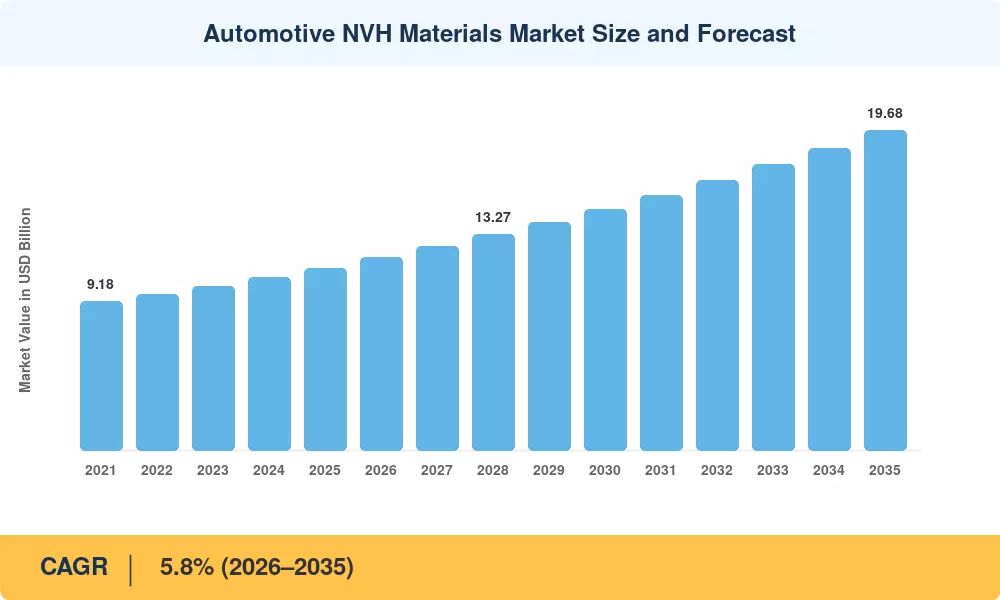
NEW YORK, NY, UNITED STATES, August 31, 2026 /EINPresswire.com/ -- According to Market Research Future, the Automotive NVH Materials Market is projected to grow from USD 11.85 billion in 2026 to USD 19.68 billion by 2035, registering a CAGR of 5.8% during the forecast period 2026 to 2035, driven by Growing demand for lightweight, high-performance materials. This steady growth reflects the increasing importance of acoustic and vibration management in modern vehicles, where materials engineering has become essential for delivering the quiet, refined cabin experiences that consumers increasingly expect.Market Overview
Automotive NVH (Noise, Vibration, and Harshness) materials are specialized solutions designed to mitigate unwanted sounds, vibrations, and harshness within vehicle cabins . These materials include rubber compounds, acoustic foams, engineered resins, fiber felts, films, sheets, and textile composites that are strategically integrated into vehicle architectures to absorb, dampen, or insulate against noise and vibration. As vehicles become quieter due to electrification and more refined due to consumer expectations, NVH materials have transitioned from afterthought engineering to critical design elements .
The key growth drivers propelling this market expansion include the rapid shift toward electric vehicles, which has fundamentally altered the acoustic landscape of vehicle interiors . Without internal combustion engines to mask wind, tire, and road noise, EVs demand targeted acoustic solutions for motor whine, inverter noise, and aerodynamic sounds that were previously concealed . The growing consumer expectation for premium in-cabin experiences, particularly in the luxury and mid-range segments, further drives NVH material adoption . Stricter international noise regulations and the ongoing automotive lightweighting trend, which alters vibration transmission characteristics, also contribute to market growth .
Technological developments are reshaping the NVH materials landscape at an accelerating pace. The industry is witnessing a significant shift toward lightweight, high-performance materials that balance acoustic effectiveness with vehicle weight reduction. Multi-layer acoustic packages, microporous sound absorbers, and advanced damping films are being developed to address the unique noise profiles of electric vehicles . The integration of AI-driven simulation tools is enabling engineers to predict acoustic performance before physical prototyping, reducing development cycles and optimizing material selection . The Acoustic Materials Market has seen parallel growth, with automotive noise control emerging as a major application segment alongside building and industrial acoustics .
📍 Get Free Sample Report for Detailed Market Insights:
https://www.marketresearchfuture.com/sample_request/10729
Market Segmentation
The automotive NVH materials market is segmented based on material type, application, and vehicle type to provide comprehensive insights into the industry landscape.
By Material Type: The market is categorized into Rubber, Foam, Film & Sheet, Engineered Resins, and Others including fiber felts and textile composites. Foam materials, particularly polyurethane and polypropylene foams, dominate the segment due to their excellent sound absorption properties, lightweight characteristics, and versatility across multiple vehicle applications . Rubbers, including EPDM and nitrile rubber, are widely used for damping applications, offering superior vibration isolation and durability. Engineered resins and film/sheet materials are gaining traction as manufacturers seek multi-functional solutions that combine acoustic performance with structural integrity . The shift toward sustainable materials is driving innovation in bio-based foams, natural fiber composites, and recycled-content acoustic materials .
By Application: The market is segmented into Damping, Absorption, and Insulation applications . Damping materials, which dissipate vibrational energy and reduce structure-borne noise, represent the largest application segment, particularly for floor panels, body panels, and chassis components . Absorption materials, including foams and fiber felts, are critical for managing airborne noise in areas such as headliners, dash insulators, and wheel well liners. Insulation materials, which block sound transmission, are essential for firewall and bulkhead applications, particularly in electric vehicles where high-frequency motor noise requires targeted insulation strategies .
By Vehicle Type: The market covers Passenger Cars, Light Commercial Vehicles, Heavy Commercial Vehicles, and Electric Vehicles . Passenger cars constitute the largest segment, driven by high production volumes and consumer demand for quiet, refined cabins. Electric vehicles represent the fastest-growing segment, as the absence of combustion engine noise amplifies wind, tire, and motor sounds, requiring significantly higher NVH material content per vehicle . Light commercial vehicles are gaining traction as fleet operators prioritize driver comfort and fatigue reduction. Heavy commercial vehicles, while representing a smaller share, demand robust NVH solutions for extended operational hours and harsh operating conditions .
By Region: The market analysis covers North America, Europe, South America, Asia Pacific, and the Middle East and Africa.
🛒 You can buy this market report at:
https://www.marketresearchfuture.com/checkout?currency=one_user-USD&report_id=10729
Regional Analysis
Asia Pacific represents the dominant and fastest-growing regional market for automotive NVH materials, driven by the region's position as the world's largest automotive manufacturing hub. China, the global leader in vehicle production with over 30 million vehicles built in 2023, is investing heavily in NVH solutions to meet rising consumer expectations and stringent emissions regulations . India's push toward electric mobility, supported by a substantial PLI scheme for battery manufacturing, is creating demand for NVH solutions tailored to electric vehicle applications . Japan and South Korea, home to automakers such as Toyota and Hyundai, are investing in high-performance NVH materials to enhance vehicle comfort and meet global regulatory standards .
North America represents a mature and significant market, supported by strong vehicle production, rigorous noise regulations, and high consumer expectations for cabin comfort. The United States, which produced over 10.6 million vehicles in 2023 and registered more than 1.2 million EV units, demonstrates robust demand for specialty NVH materials . The Department of Energy's focus on battery noise reduction has further augmented the need for targeted acoustic solutions . The region benefits from innovations in lightweight and eco-friendly materials, with 3M, BASF, and DuPont applying advanced composites for cabin acoustic improvements .
Europe maintains a robust market position, shaped by stringent EU noise and emission standards alongside the growing EV market. Electric vehicles accounted for a significant share of new car registrations in the European Union, increasing the need for enhanced NVH solutions . Germany leads the region with investments in lightweight NVH materials to meet high energy efficiency requirements. The European Commission's sustainability initiatives have accelerated innovations in recyclable NVH materials, with companies like Autoneum, Henkel, and Sika AG developing high-performance acoustic insulation .
Latin America represents an emerging market with growing potential. Brazil, the largest automotive producer in the region, produced over 2.2 million vehicles in 2023, creating significant demand for NVH solutions . Mexico, a major automotive export hub, is incorporating advanced NVH materials to meet global emission and noise standards. Local manufacturers are increasingly investing in bio-based and recycled NVH materials to meet sustainability goals .
The Middle East and Africa are gradually developing markets driven by rising vehicle production and infrastructure expansion. Turkey, the region's leader in automotive manufacturing, produced close to 1.47 million vehicles in 2023, driving demand for advanced NVH solutions . The region is moving steadily toward advanced acoustic and vibration control technologies with multinational players investing in local production and research .
Competitive Landscape and Key Players
The automotive NVH materials market is highly competitive, featuring a mix of established global chemical and materials companies, specialized acoustic solution providers, and regional manufacturers. The competitive landscape is characterized by technological innovation, strategic partnerships, and sustainability-focused product development.
Key players operating in this market include BASF SE, 3M Company, The Dow Chemical Company, Covestro AG, Huntsman Corporation, Lanxess AG, Borgers AG, Sumitomo Riko Company Limited, Mitsui Chemicals, Celanese Corporation, ExxonMobil, and Autoneum . BASF SE, for instance, has strengthened its position through strategic partnerships focused on sustainable material production, including a collaboration with 3B Fibreglass to enhance the sustainable production of Ultramid polyamide for automotive NVH applications .
Strategic developments are reshaping the competitive landscape. Companies are prioritizing R&D investments to improve the precision, reliability, and sustainability of NVH materials . Efforts to expand reach through partnerships with governmental agencies, academic institutions, and automotive OEMs are ongoing . The industry is witnessing a shift from late-stage acoustic correction to "NVH by design," where materials are integrated into vehicle architecture from the conceptual stage . Collaborations between materials developers, acoustic modelers, and OEM engineering teams have become more common, shortening design cycles through concurrent engineering .
Innovation and technology initiatives are accelerating across the industry. Companies are developing next-generation materials that balance acoustic performance with environmental sustainability . The shift toward lightweight, recyclable, and low-emission acoustic components reflects the industry's focus on circular economy principles and life-cycle assessment requirements . Mergers and partnerships focused on capability rather than size are shaping competitive dynamics, enabling nimble firms to access new channels and technical competencies without diluting engineering focus .
Latest Industry News and Developments
Recent industry developments highlight the dynamic nature of the automotive NVH materials market. In May 2024, BASF SE announced a strategic partnership with 3B Fibreglass to improve sustainable production of its Ultramid polyamide, used in the automotive sector for NVH and other critical applications, by leveraging 3B's sustainably produced fiber glass . This partnership demonstrates the industry's focus on sustainability as a competitive differentiator.
In the broader acoustic materials market, March 2026 saw Knauf Insulation roll out its next-generation Acoustic Air glass mineral wool batts engineered with ECOSE Technology, targeting enhanced Sound Transmission Class ratings . While focused on building applications, such developments signal the ongoing innovation in acoustic material formulations that may translate to automotive applications.
Technology demonstration projects continue to advance NVH material capabilities. Leading suppliers are demonstrating next-generation acoustic packages featuring lightweight multi-layer solutions, microporous absorbers, and bio-based foam formulations designed for electric vehicle applications. These developments underscore the industry's commitment to creating quieter, lighter, and more sustainable vehicles.
Market Challenges and Opportunities
The automotive NVH materials market faces several key challenges that could impact growth trajectories. Balancing weight reduction with acoustic performance remains a significant engineering challenge, particularly as vehicle electrification and lightweighting demand materials that are both effective and efficient . Regulatory compliance across different regions, including emissions, recycling mandates, and chemical restrictions, adds complexity to product development and market entry strategies . The volatility of raw material prices, particularly for petroleum-based polymers and foams, creates cost pressure on material manufacturers and downstream users . The complexity of integrating multiple material types into vehicle architectures requires substantial engineering and validation resources, particularly for global vehicle platforms .
Emerging opportunities are abundant in the evolving mobility landscape. The accelerating shift toward electric vehicles creates significant demand for specialized NVH materials that address motor whine, inverter noise, and aerodynamic sounds . The integration of active noise control technologies presents complementary opportunities, with passive materials increasingly paired with electronic sound management systems . The growing emphasis on sustainability is creating demand for recyclable, bio-based, and low-VOC NVH materials that meet both environmental regulations and consumer expectations . The expansion of vehicle production in emerging markets, particularly in Asia Pacific and Latin America, presents opportunities for localized manufacturing and material innovation .
Future growth potential remains steady, driven by the ongoing transformation of vehicle architectures toward quieter, lighter, and more sustainable platforms. As vehicle electrification continues and consumer expectations for cabin refinement rise, the importance of sophisticated NVH materials will only increase. Manufacturers that embrace innovation, build resilient supply chains, and develop comprehensive material solutions will capture value in the evolving NVH ecosystem.
To explore more market insights, visit us at:
https://www.marketresearchfuture.com/reports/automotive-nvh-materials-market-10729
Final Market Summary
The automotive NVH materials market is positioned for steady growth, driven by vehicle electrification, consumer expectations for cabin refinement, and regulatory requirements. The market's trajectory from USD 11.85 billion in 2026 to USD 19.68 billion by 2035 reflects the increasing importance of acoustic and vibration management in modern vehicle design.
The long-term industry potential remains strong, with advancements in lightweight materials, acoustic engineering, and sustainable manufacturing continuing to expand the addressable market. The convergence of NVH materials with broader vehicle technology trends, including lightweighting, electrification, and connected vehicle platforms, is creating comprehensive solutions that serve diverse customer needs across vehicle segments and geographic regions.
Key factors expected to influence future development include the pace of electric vehicle adoption, technological advancements in sustainable materials, and the evolution of regulatory frameworks. The development of bio-based foams, natural fiber composites, and recyclable acoustic materials will address sustainability concerns while maintaining performance standards. Investment in AI-driven simulation tools and digital validation capabilities will accelerate material qualification and reduce development cycles.
The transformation from afterthought acoustic treatments to integrated "NVH by design" engineering represents a fundamental industry evolution, positioning NVH materials as essential components of the sustainable mobility ecosystem. As vehicles become increasingly quiet, efficient, and refined, the role of NVH materials will continue to expand, ensuring sustained innovation and growth throughout the forecast period and beyond.
More Related Reports from MRFR Library:
Luxury Yacht Market : https://www.marketresearchfuture.com/reports/luxury-yacht-market-10884
Hydraulic Pumps Market : https://www.marketresearchfuture.com/reports/hydraulic-pumps-market-7736
Forklift Battery Market : https://www.marketresearchfuture.com/reports/forklift-battery-market-30496
Pipeline Transportation Market : https://www.marketresearchfuture.com/reports/pipeline-transportation-market-11952
Clean Energy Technology Market : https://www.marketresearchfuture.com/reports/clean-energy-technology-market-36038
Direct Air Capture Market : https://www.marketresearchfuture.com/reports/direct-air-capture-market-21897
Personal Protective Equipment [PPE] Market : https://www.marketresearchfuture.com/reports/personal-protective-equipment-market-3826
Hydraulic Dosing Pump Market : https://www.marketresearchfuture.com/reports/hydraulic-dosing-pump-market-30235
Floating Solar Panel Market : https://www.marketresearchfuture.com/reports/floating-solar-panels-market-6564
Diesel Particulate Filter Market : https://www.marketresearchfuture.com/reports/diesel-particulate-filter-market-6274
Market Research Future
Market Research Future
+1 855-661-4441
email us here
Legal Disclaimer:
EIN Presswire provides this news content "as is" without warranty of any kind. We do not accept any responsibility or liability for the accuracy, content, images, videos, licenses, completeness, legality, or reliability of the information contained in this article. If you have any complaints or copyright issues related to this article, kindly contact the author above.
