

Automotive Vacuumless Braking Market to Reach USD 4.97 Billion by 2035 at 5.9% CAGR
Automotive Vacuumless Braking Market
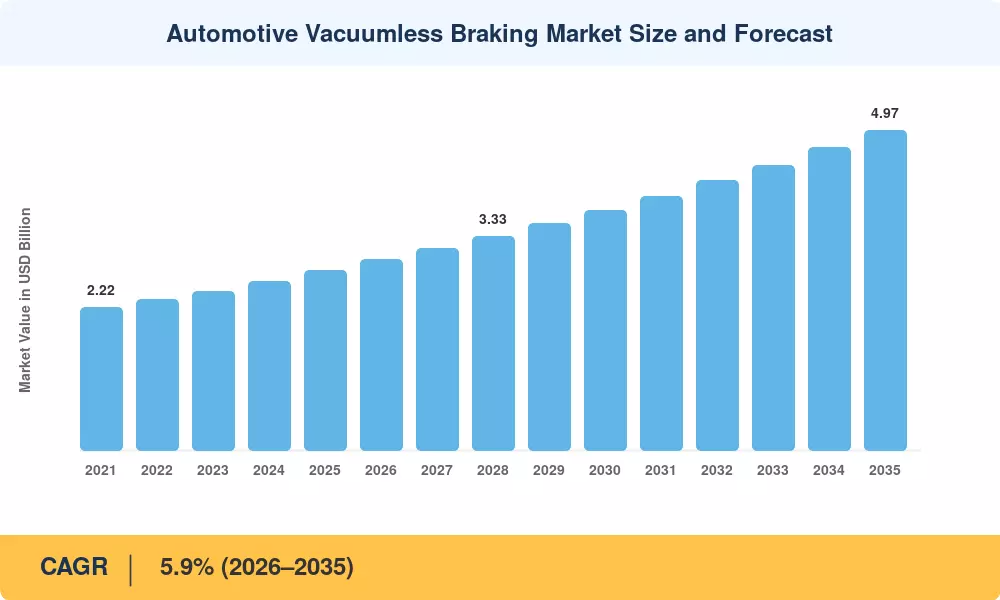
The automotive vacuumless braking market reached an estimated USD 2.80 billion in 2025 and is projected to grow from USD 2.97 billion in 2026.
The automotive vacuumless braking market reached an estimated USD 2.80 billion in 2025 and is projected to grow from USD 2.97 billion in 2026 to USD 4.97 billion by 2035.”
NEW YORK, NY, UNITED STATES, July 23, 2026 /EINPresswire.com/ -- The automotive vacuumless braking market reached an estimated USD 2.80 billion in 2025 and is projected to grow from USD 2.97 billion in 2026 to USD 4.97 billion by 2035, registering a CAGR of 5.9% during the forecast period.— Arti Dhapte
Market Overview
Automotive vacuumless braking refers to brake systems that generate stopping force without the vacuum-assisted booster used in conventional internal combustion engine vehicles, relying instead on electromechanical and electro-hydraulic mechanisms . These advanced systems encompass brake-by-wire architectures, electric brake boosters, and one-box integrated braking units that eliminate the need for engine vacuum. The technology is becoming structurally essential as the global vehicle fleet electrifies, because battery-electric powertrains produce no engine vacuum, making vacuumless braking a requirement rather than an optional upgrade .
The defining growth driver is the convergence of electrification and automated driving. Electric vehicles inherently lack the vacuum source for traditional boosters, while advanced driver-assistance and higher-level automation demand the precise, individually modulated, and redundant braking that by-wire systems provide . As suppliers commercialise dry brake-by-wire platforms that remove hydraulic fluid entirely, braking is shifting from a purely mechanical function toward a software-defined, sensor-rich domain, expanding the value of the systems fitted to each new vehicle through the forecast period.
Industry trends indicate a decisive shift toward dry electromechanical brake-by-wire and integrated one-box systems. The most consequential development of 2025 and 2026 is the move of dry brake-by-wire from prototype to volume production. Dry systems remove hydraulic fluid, brake lines, and the master cylinder entirely, replacing them with electric actuators at each wheel and a control unit that modulates braking force individually . One-box integrated systems that combine boosting and electronic stability control in a single compact unit are increasingly favoured for their packaging efficiency in electrified platforms .
Technological developments are rapidly expanding the market's capabilities and application scope. Bosch road-tested a new hydraulic brake-by-wire system over more than 3,300 kilometres across multiple climate zones reaching the Arctic Circle, validating an architecture that removes the mechanical link between pedal and brakes . Leading suppliers are broadening their portfolios to offer flexible by-wire architectures, with ZF launching a comprehensive brake-by-wire technology portfolio spanning purely electric dry systems, purely hydraulic systems, and hybrid configurations, all engineered to support up to Level 4 automated driving . This modular approach lets carmakers match braking architecture to vehicle positioning and timeline, lowering the barrier to adoption.
Policy and regulatory influence on the market is substantial and growing. Regulatory bodies worldwide are imposing stricter safety standards that require more reliable and effective braking systems, pushing automakers to adopt advanced technologies such as vacuumless braking . The European Union's General Safety Regulation mandates advanced braking capabilities that align with by-wire architectures . In China, new energy vehicle production and sales surpassed 12 million units in 2024, representing 40.9% of total new vehicle trade, creating massive demand for vacuumless braking systems .
The demand outlook remains positive, with the market poised for sustained growth through 2035. North America is a key market, supported by early adoption of advanced braking technologies, strong demand for safety and automated-driving features, and a robust base of original-equipment and tier-one engineering . Asia-Pacific is the fastest-growing region, driven by China's electric-vehicle and by-wire adoption, with domestic manufacturers racing to differentiate on software-defined chassis features .
📍 Get Free Sample Report for Detailed Market Insights:
https://www.marketresearchfuture.com/sample_request/34839
Market Segmentation
By Vehicle Type
The market is segmented by vehicle type into Passenger Cars and Commercial Vehicles. Passenger cars dominate the market, reflecting high electrified-model penetration and consumer demand for advanced safety and assisted-driving features . Commercial vehicles represent a growing demand layer where electrification and stringent safety requirements increasingly favour electronically controlled, vacuum-independent braking. As global logistics and transportation sectors expand, commercial vehicle adoption is accelerating .
By Electric Vehicle Type
Electric vehicle type segmentation covers Battery Electric Vehicles (BEV), Plug-in Hybrid Electric Vehicles (PHEV), and Other Vehicles. Battery-electric vehicles are the fastest-growing sub-segment, as electric powertrains lack the engine vacuum required for traditional boosters and therefore depend on vacuumless braking by design . PHEVs also represent a significant market share, with manufacturers focusing on integrating advanced braking technologies suited for hybrid systems, including regenerative braking capabilities .
By Sales Channel
Sales channel segmentation includes OEMs and Aftermarket. The OEM channel captures the majority of demand, as vacuumless braking systems are increasingly specified as standard equipment on new electrified and automated vehicle platforms . The aftermarket segment is emerging as replacement demand grows with the aging vehicle fleet.
By Region
Regional segmentation includes North America, Europe, Asia Pacific, South America, and the Middle East and Africa. North America dominated the market in 2025, supported by early adoption and a robust tier-one engineering base. Asia-Pacific is the fastest-growing region, driven by China's electric-vehicle and by-wire adoption .
🛒 You can buy this market report at:
https://www.marketresearchfuture.com/checkout?currency=one_user-USD&report_id=34839
Regional Analysis
North America
North America dominated the market in 2025, supported by early adoption of advanced braking technologies, strong demand for safety and automated-driving features, and a robust base of original-equipment and tier-one engineering . The United States is the largest national market, with NHTSA rulemaking on enhanced braking performance and safety standards driving adoption. The region is projected to grow at a CAGR of approximately 6.3% over the forecast period .
Europe
Europe represents a significant market driven by stringent safety regulations and the rapid adoption of electric vehicles. The EU's General Safety Regulation mandates advanced braking capabilities, and the region's commitment to reducing carbon emissions is accelerating the transition to electrified platforms . Germany, home to key players such as Bosch and Continental, anchors regional demand through its concentration of premium OEMs and Tier-1 suppliers.
Asia-Pacific
Asia-Pacific is the fastest-growing region, driven by China's electric-vehicle and by-wire adoption . China's new energy vehicle production and sales surpassed 12 million units in 2024, representing 40.9% of total new vehicle trade . Domestic manufacturers are racing to differentiate on software-defined chassis features, reinforcing the region's emergence as the fastest-growing arena for vacuumless braking technology . India, Japan, and South Korea are also key markets, with increasing EV adoption and regulatory support.
South America
South America represents a developing market for vacuumless braking, with growth driven by the gradual adoption of electric vehicles and the modernization of automotive safety standards in countries such as Brazil and Argentina.
Middle East and Africa
The Middle East and Africa region is an emerging market for vacuumless braking, with growth driven by fleet modernization programs and the gradual adoption of advanced safety technologies in the Gulf Cooperation Council states and South Africa.
Competitive Landscape / Key Players
The automotive vacuumless braking market is characterized by the presence of several global and regional players competing on technology innovation, product quality, and service capabilities. Key companies operating in this market include Robert Bosch GmbH, Continental AG, ZF Friedrichshafen AG, Brembo S.p.A., Aisin Corporation, Hitachi Astemo, Ltd., Knorr-Bremse AG, Denso Corporation, BorgWarner Inc., and ADVICS CO., Ltd.
Strategic developments in the market include significant product launches, partnerships, and capacity expansions. In 2026, Brembo announced that its Sensify brake-by-wire platform entered series production for an unnamed leading global vehicle manufacturer, fitted as standard on every vehicle in the launch programme, marking the most significant deployment of brake-by-wire technology in two decades . In July 2025, ZF launched a comprehensive brake-by-wire technology portfolio offering automakers flexible options spanning purely electric dry, purely hydraulic, and hybrid configurations, all designed to support up to Level 4 automated driving .
Competitive differentiation increasingly hinges on software-defined braking capabilities, flexible by-wire architectures, and the ability to integrate braking with broader vehicle automation platforms. The industry is transitioning from pure hardware supply to offering modular, scalable brake-by-wire systems that align with different vehicle platforms and automation roadmaps .
Latest Industry News & Developments
Recent industry developments highlight the ongoing transformation of the automotive vacuumless braking market toward software-defined, by-wire architectures and flexible platforms. In 2026, Brembo announced that its Sensify brake-by-wire platform entered series production for an unnamed leading global vehicle manufacturer, fitted as standard on every vehicle in the launch programme, with the company expecting to equip hundreds of thousands of vehicles per year across multiple contracts .
In July 2025, ZF launched a comprehensive brake-by-wire technology portfolio offering automakers flexible options spanning purely electric dry, purely hydraulic, and hybrid configurations, all designed to support up to Level 4 automated driving . The modular launch lets carmakers match braking architecture to specific platforms and automation roadmaps, accelerating the industry's shift away from vacuum-dependent boosters.
In February 2025, Bosch reported the successful public-road testing of its new hydraulic brake-by-wire system, covering more than 3,300 kilometres across different climate zones up to the Arctic Circle. The system eliminates the mechanical connection between the brake pedal and the brakes, enhancing safety and responsiveness while validating cold-climate reliability .
Market Challenges & Opportunities
Key restraints facing the automotive vacuumless braking market include high component costs and technical complexity, with sophisticated braking systems relying on expensive sensors, high-speed electric motors, and advanced control units, resulting in a notably higher bill of materials compared to traditional vacuum boosters . This price sensitivity restricts integration to premium vehicle segments, preventing widespread adoption in cost-sensitive entry-level and mid-range models. The severe economic pressure affecting the automotive supply chain limits liquidity for developing complex safety-critical systems, with capital investment in EV components dropping to its lowest level since 2019 .
Emerging opportunities in the market are substantial and diverse. The transition to one-box integrated brake systems, which consolidate the master cylinder, vacuum booster, and electronic stability control into a single compact unit, enables maximum regenerative braking efficiency while significantly reducing vehicle weight and assembly complexity . The emergence of dry electromechanical brake-by-wire technology represents the next evolutionary step, eliminating hydraulic fluid entirely to create a "dry" system that simplifies maintenance and enhances environmental sustainability .
Future potential lies in braking becoming a software-defined safety enabler for higher-level automated driving. As automated and assisted driving require braking that is precise, individually modulated at each wheel, and redundant for fail-operational safety, braking control migrates into software and electronics, becoming tunable over the vehicle's life and integral to the broader software-defined vehicle . This raises both the technical bar and the value attached to vacuumless braking hardware. Suppliers that develop scalable by-wire platforms and secure volume production commitments from global vehicle manufacturers will capture significant market share.
To explore more market insights, visit us at:
https://www.marketresearchfuture.com/reports/automotive-vacuumless-braking-market-34839
Final Market Summary
The automotive vacuumless braking market is positioned for strong growth through 2035, driven by the rapid electrification of the global vehicle fleet, the commercial arrival of dry brake-by-wire systems, and braking's transformation into a software-defined enabler of autonomous driving. The projected valuation of USD 4.97 billion reflects rapidly expanding adoption across passenger and commercial vehicles, with the market transitioning from vacuum-dependent architectures to electromechanical and electro-hydraulic by-wire solutions.
The medium-term growth outlook remains positive, with the market registering a CAGR of 5.9% during the forecast period. North America will continue to maintain market leadership through early adoption of advanced braking technologies, while Asia-Pacific emerges as the fastest-growing region driven by China's EV production and by-wire adoption. The ongoing development of dry brake-by-wire platforms, integrated one-box systems, and modular by-wire architectures will continue to expand market possibilities and applications.
Long-term industry potential extends beyond the current forecast horizon. The global electric vehicle stock is projected to surpass 250 million units by 2035, each requiring vacuumless braking by design . Dry brake-by-wire systems that remove hydraulic fluid entirely will become increasingly prevalent, marking braking's transition into a software-defined vehicle domain. The convergence of electrification, automated driving, and software-defined vehicle architectures will continue to reshape the competitive landscape. Manufacturers that successfully commercialise scalable by-wire platforms, invest in flexible architectures suited to different automation levels, and secure volume production commitments from global OEMs will capture substantial value in this evolving market. The transformation of braking from a purely mechanical function to an intelligent, software-defined safety domain represents a fundamental advancement in vehicle dynamics, enabling the next generation of electrified and autonomous mobility.
More Related Reports from MRFR Library:
Automotive Dealer Management System Market: https://www.marketresearchfuture.com/reports/automotive-dealer-management-system-market-28652
Atv Utv Tire Market: https://www.marketresearchfuture.com/reports/atv-utv-tire-market-28706
Automobile Oil Pump Market: https://www.marketresearchfuture.com/reports/automobile-oil-pump-market-28723
America Golf Cart Market: https://www.marketresearchfuture.com/reports/america-golf-cart-market-28754
Dock Yard Management System Market: https://www.marketresearchfuture.com/reports/dock-yard-management-system-market-28832
Car Cleaning Product Market: https://www.marketresearchfuture.com/reports/car-cleaning-product-market-29580
Automobile Oxygen Sensor Market: https://www.marketresearchfuture.com/reports/automobile-oxygen-sensor-market-29750
Automotive In Wheel Market: https://www.marketresearchfuture.com/reports/automotive-in-wheel-market-29787
Auto Leasing Service Market: https://www.marketresearchfuture.com/reports/auto-leasing-service-market-29802
Automotive Wireless Charger Market: https://www.marketresearchfuture.com/reports/automotive-wireless-charger-market-29815
Larry Wilson
WantStats Research And Media Pvt. Ltd.
+1 855-661-4441
email us here
Legal Disclaimer:
EIN Presswire provides this news content "as is" without warranty of any kind. We do not accept any responsibility or liability for the accuracy, content, images, videos, licenses, completeness, legality, or reliability of the information contained in this article. If you have any complaints or copyright issues related to this article, kindly contact the author above.
