

Automotive Display Market Share Projected to Hit USD 71.42 Billion, at a Growing CAGR of 10.30%, During 2026 to 2035
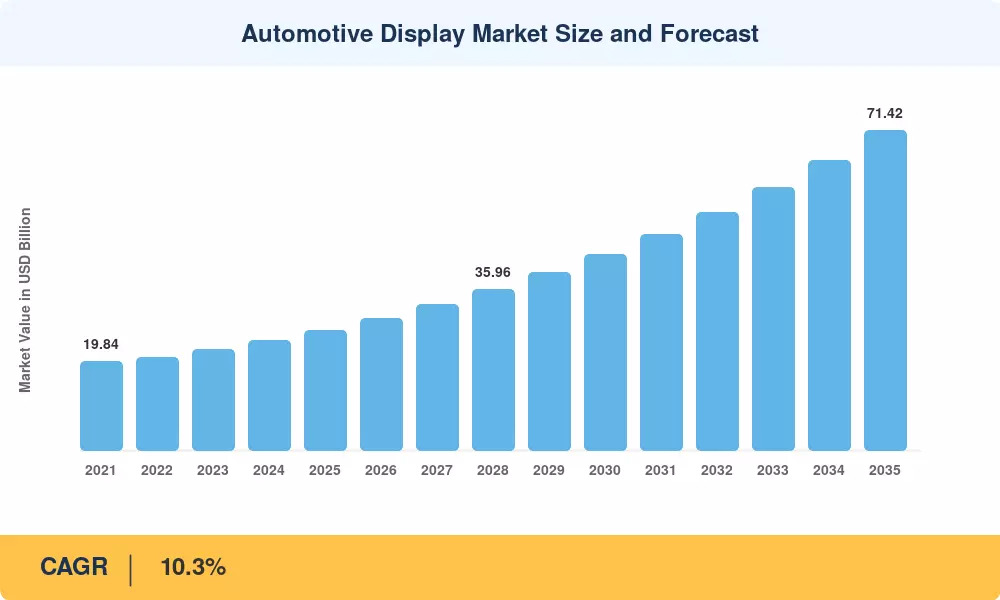
Automotive Display Market Summary
Asia-Pacific captured approximately 49.5% of the Automotive Display Market in 2025, with China alone representing over half of the regional revenue.
Center stack displays accounted for approximately 43% of the Automotive Display Market in 2025, underscoring their role as the primary HMI surface in modern cockpits.”
NY, CA, UNITED STATES, July 14, 2026 /EINPresswire.com/ -- Automotive displays are sophisticated electronic visual interfaces integrated into vehicles to provide critical information, entertainment, and control functions to drivers and passengers. These displays have evolved from simple instrument clusters to advanced, high-resolution interactive screens that serve as the primary hub for vehicle data, navigation, infotainment, and vehicle settings. The display ecosystem encompasses center stack displays, instrument clusters, head-up displays (HUDs), rear-seat entertainment screens, and other auxiliary displays that together form the digital cockpit. Modern automotive displays leverage technologies such as TFT-LCD, LTPS (Low Temperature Poly Silicon) LCD, OLED, and emerging MicroLED to deliver higher brightness, better contrast, and lower power consumption while enabling innovative form factors and free-form designs . These displays are increasingly integrated with AI-powered voice controls and haptic feedback, transforming the vehicle interior into an intelligent, personalized, and safer environment .— Arti Dhapte
Automotive Display Market Overview
The automotive display market size is positioned for robust growth through 2035, driven by the accelerating transition to electric and connected vehicles, the integration of ADAS, and increasing consumer expectations for immersive digital experiences. The projected valuation of USD 71.42 billion, growing at a CAGR of 10.3%, reflects the transformation of displays from standalone modules into coordinated, intelligent cockpit systems that are central to the modern vehicle experience.
The market is experiencing strong growth driven by several fundamental factors. The growing adoption of advanced driver-assistance systems (ADAS) is a primary catalyst, as these systems require high-quality displays to present real-time visual data for functions like lane-keeping assist, adaptive cruise control, and parking assist . The rising consumer preference for connected vehicles and advanced infotainment is fueling demand for larger, higher-resolution displays that support smartphone integration, OTT content streaming, and cloud gaming . The rapid expansion of the electric vehicle (EV) market creates significant demand, as EVs typically feature advanced digital cockpits and large touchscreens for monitoring battery status, range, and energy consumption . Additionally, regulatory mandates requiring rear-view cameras and other safety features are driving base-level display adoption .
Industry trends indicate a decisive shift toward larger, more integrated, and software-defined display systems. The average size of center information displays (CIDs) is growing rapidly, with 10-15 inch screens becoming the most common segment, accounting for 60% of shipments in 2025 . The total area of CIDs increased by 19% year-over-year in 2025, driven by larger display sizes . The market is moving toward coordinated cockpit visualization systems where displays function as integrated modules rather than standalone components . HUDs are experiencing the fastest growth, expanding 25.3% year-over-year, with 3.1-inch and above units now accounting for over 50% of shipments, marking a milestone toward augmented reality HUD deployment .
Technological developments are reshaping display capabilities. LTPS TFT LCD is rapidly displacing traditional a-Si LCD, offering higher resolution, greater brightness, lower power consumption, and enhanced touch panel integration . OLED is gaining ground due to its thin form factor, high contrast ratio, power efficiency, and support for free-form designs, expanding across center stack, instrument cluster, and passenger displays . In the first half of 2025, LTPS LCD surged to 46.4% of CSD shipments, while AMOLED penetration nearly doubled to 2.1%, driven by premium EVs and flagship cockpit programs . Omdia forecasts LTPS TFT LCD will exceed 50% of shipment revenue by 2028, while OLED is expected to dominate the high-end cockpit segment with over 20% revenue share by 2028 . MicroLED is expected to enter the market after 2028, marking the next wave of advanced display technologies .
Policy and regulatory influence on the automotive display market is significant. European New Car Assessment Programme (Euro NCAP) testing standards are mandating the inclusion of physical controls to reduce reliance on touchscreens, influencing display design and interface integration . New draft regulations in China from the Ministry of Industry and Information Technology are also shaping display requirements . Vehicle safety regulations requiring ADAS features and rear-view cameras are driving display adoption across vehicle segments . The shift toward zonal compute architectures and the need for compliance with evolving safety and cybersecurity standards are shaping display integration strategies .
The demand outlook remains strongly positive, with display panel revenues projected to reach USD 13.6 billion in 2025, an 8% year-over-year increase, and further growth to USD 18.3 billion by 2030 . The global automotive display market hit 120.96 million units in the first half of 2025, up 5.1% year-on-year . North America leads the market due to constant adoption of advanced automotive solutions , while Asia-Pacific is expected to expand at the fastest growth rate, driven by rapid urbanization, industrialization, and the massive automobile industry in China and India . Europe holds a substantial share, supported by stringent safety regulations and the presence of major automotive manufacturers .
📍 Get Free Sample Report for Detailed Market Insights:
https://www.marketresearchfuture.com/sample_request/6954
Automotive Display Market Segmentation
By Product Type
The automotive display market is segmented by product type into Center Stack Display, Instrument Cluster Display, Head-Up Display, Rear-Seat Entertainment Display, and Others. Center stack displays hold the largest market share, driven by their role as the primary interface for infotainment, navigation, climate control, and vehicle settings . The CSD segment grew 2.0% year-over-year in the first half of 2025, though incremental growth has moderated due to high factory pre-install penetration . The instrument cluster segment is the fastest-growing, increasing 16.8% year-over-year, with smaller clusters (under six inches) growing fastest, supported by compact EV adoption and entry-level models in emerging markets . Head-up displays are experiencing the strongest growth at 25.3% year-over-year, driven by larger projection optics and the shift toward AR-HUD deployment . Rear-seat entertainment displays serve passenger convenience, particularly in premium vehicles and fleet applications.
By Display Technology
Technology segmentation includes Liquid Crystal Display (LCD), Organic Light-Emitting Diode (OLED), and Others (MicroLED, E-Paper). LCD remains the dominant technology, benefiting from a mature supply chain and large manufacturing capacity . However, within LCD, LTPS TFT LCD is rapidly displacing traditional a-Si LCD due to superior performance . In the first half of 2025, a-Si LCD's share in CSD applications fell from 69.6% to 51.0%, while LTPS LCD surged from 29.1% to 46.4% . OLED is the fastest-growing technology, gaining share in premium vehicles due to its design flexibility, high contrast, and power efficiency . AMOLED penetration in CSD nearly doubled to 2.1% in the first half of 2025 . Omdia forecasts LTPS TFT LCD and OLED combined will exceed 50% of total automotive display revenue in 2025, signaling a shift toward higher value-added display technologies .
By Vehicle Type
Vehicle type segmentation includes Passenger Cars and Commercial Vehicles. Passenger cars represent the largest segment, driven by consumer demand for advanced infotainment, navigation, and connectivity features . The integration of smart displays is increasingly standard in passenger vehicles, particularly in mid-range and premium models . Commercial vehicles are a growing segment, with fleet operators adopting advanced displays for telematics, driver monitoring, and logistics optimization . Electric vehicles are a key growth driver across both segments, as they typically feature more advanced and larger displays than ICE vehicles .
By Display Size
Display size segmentation includes ≤5-Inch, 6–10 Inch, and >10 Inch. The >10-inch segment is the fastest-growing, driven by consumer preference for larger displays that integrate multiple functions, support navigation and entertainment, and enhance the premium feel of the vehicle interior . The share of CIDs measuring 15 to 20 inches increased to 11% in 2025 from 7% in 2024, with Chinese automakers leading in the adoption of largest displays . The 10-15 inch size range remained the most common, increasing to 60% of shipments in 2025 from 54% in 2024 . The 6-10 inch segment continues to serve mid-range vehicles and entry-level models. Instrument clusters under six inches are growing fastest in the IC segment, driven by compact EVs .
By Region
Regional segmentation includes North America, Europe, Asia-Pacific, South America, and the Middle East and Africa. North America leads the market due to high adoption of advanced automotive solutions and the presence of major market players . Asia-Pacific is the fastest-growing region, driven by rapid industrialization and modernization in China and India . Europe holds a substantial share supported by stringent safety regulations and a high concentration of automotive manufacturers .
🛒 You can buy this market report at:
https://www.marketresearchfuture.com/checkout?currency=one_user-USD&report_id=6954
Automotive Display Market Competitive Landscape
The automotive display market exhibits moderate concentration, with key players spanning display panel manufacturers, automotive Tier-1 suppliers, and technology companies. Key companies include Continental AG, Robert Bosch GmbH, Denso Corporation, LG Display Co. Ltd., Panasonic Corporation, Visteon Corporation, Yazaki Corporation, 3M Company, Valeo SA, Harman International, Pioneer Corporation, and Nippon Seiki Co. Ltd.
Continental AG is a leading Tier-1 supplier offering comprehensive display solutions, including instrument clusters, center stack displays, and HUDs, with strong European OEM partnerships . Robert Bosch GmbH provides advanced display systems integrated with its broad automotive electronics portfolio, focusing on driver safety and infotainment . LG Display Co. Ltd. is a dominant display panel manufacturer, expanding its automotive OLED and LTPS LCD offerings for premium vehicle cockpits . Denso Corporation serves as a Toyota ecosystem anchor supplier, offering instrument clusters and HUDs . Panasonic Corporation provides a wide range of display solutions for infotainment and connectivity, with a strong presence in North American and Japanese markets .
Strategic developments include aggressive expansion into the automotive segment by panel makers such as AUO, BOE, ChinaStar, and Tianma as LTPS TFT LCD retreats from the smartphone display market . Leading OLED manufacturers like Samsung Display, LG Display, and BOE are developing new tandem RGB OLED designs to accelerate their presence in the automotive space . Partnerships and collaborations are intensifying as the industry aims towards consolidation, with OEMs and technology companies integrating AI, voice control, and augmented reality into display systems .
Latest Industry News & Developments
Recent industry developments highlight the accelerating transformation of the automotive display market. According to Omdia's Automotive Display Intelligence Service, the global automotive display market hit 120.96 million units in the first half of 2025, up 5.1% year-on-year . While overall shipment growth moderated compared with last year's double-digit surge, the market is entering a new phase of structural transformation, shifting from screen proliferation toward coordinated, software-defined cockpit integration . Center stack display technology is advancing rapidly, with LTPS LCD surging from 29.1% to 46.4% of shipments, and AMOLED penetration nearly doubling to 2.1% . Instrument clusters increased 16.8% year-over-year, while HUDs expanded 25.3% .
Omdia forecasts that LTPS TFT LCD will become the mainstream display technology, with its shipment revenue share surpassing 50% by 2028. OLED is expected to dominate the high-end automobile cockpit segment with its shipment revenue share exceeding 20% in 2028 . Transformable MicroLED displays are expected to enter the automotive display market after 2028, marking the next wave of advanced display technologies . The market is seeing increased adoption of AI-powered voice-controlled interfaces, with carmakers partnering with tech giants to build smarter in-car ecosystems that respond intuitively to voice commands .
Automotive Display Market Challenges & Opportunities
Key restraints facing the automotive display market include high costs of advanced display technologies like OLED and 3D digital dashboards, which require sophisticated manufacturing processes and expensive materials, significantly increasing vehicle costs . Mass-market adoption is slower than anticipated, particularly in price-sensitive markets where consumers are more focused on affordability than high-end tech features . Regulatory trends mandating physical controls to reduce touchscreen reliance may limit display expansion . Supply chain disruptions and semiconductor shortages have impacted display production and automotive manufacturing . The shift toward fewer, more integrated displays rather than multiple separate screens could reduce display unit volumes .
Emerging opportunities are substantial and diverse. The rising demand for electric vehicles presents a major growth driver, as EVs typically feature advanced digital cockpits and large touchscreens for monitoring battery, range, and energy consumption . The integration of augmented reality in HUDs offers immersive forward visualization, creating new value-added features . AI-powered voice-controlled interfaces are enabling personalized experiences and reducing driver distraction . The expansion of connected vehicle features, including cloud gaming, internet streaming, and over-the-air updates, is driving demand for better-performing displays . The development of flexible, curved, and free-form displays enables innovative interior designs, creating opportunities for display manufacturers to differentiate . The growing emphasis on sustainability and driver monitoring systems in fleet applications is creating new display applications .
To explore more market insights, visit us at:
https://www.marketresearchfuture.com/reports/automotive-display-market-6954
The medium-term growth outlook remains positive, supported by the rapid adoption of advanced display technologies like LTPS LCD and OLED, the expansion of EV manufacturing, and the rising demand for HUDs and large-format displays. North America will continue to lead in revenue terms, while Asia-Pacific presents the fastest growth driven by China's massive EV production and India's automotive sector formalization. Europe maintains a strong position through regulatory-driven adoption and premium vehicle manufacturing.
Long-term industry potential extends beyond the current forecast horizon, as the convergence of autonomous driving, AI, and augmented reality creates new display requirements and revenue models. The development of MicroLED technology, the integration of AI-powered personalization, and the shift toward software-defined cockpit architectures will reshape the market landscape. Companies that successfully innovate in high-performance display technologies, build strategic partnerships with OEMs, and develop integrated software platforms will capture disproportionate value. As automotive displays become the primary interface between humans and intelligent vehicles, they will play an increasingly essential role in enabling safety, connectivity, and personalized driving experiences across the global vehicle fleet.
More Related Reports from MRFR Library:
https://www.marketresearchfuture.com/reports/automotive-lidar-sensors-market-4942
https://www.marketresearchfuture.com/reports/automotive-collapsible-steering-column-market-5132
https://www.marketresearchfuture.com/reports/mountain-bike-market-5165
https://www.marketresearchfuture.com/reports/automotive-air-suspension-system-market-5293
https://www.marketresearchfuture.com/reports/automotive-control-panel-market-5314
https://www.marketresearchfuture.com/reports/electric-vehicle-motor-market-5385
https://www.marketresearchfuture.com/reports/automotive-seat-market-5495
https://www.marketresearchfuture.com/reports/automotive-motor-market-5595
https://www.marketresearchfuture.com/reports/automotive-driver-state-monitoring-systems-market-5652
https://www.marketresearchfuture.com/reports/automotive-temperature-sensor-market-5683
Larry Wilson
WantStats Research And Media Pvt. Ltd.
+1 855-661-4441
email us here
Visit us on social media:
LinkedIn
Facebook
YouTube
X
Legal Disclaimer:
EIN Presswire provides this news content "as is" without warranty of any kind. We do not accept any responsibility or liability for the accuracy, content, images, videos, licenses, completeness, legality, or reliability of the information contained in this article. If you have any complaints or copyright issues related to this article, kindly contact the author above.
